EP.29 / Leon Rost
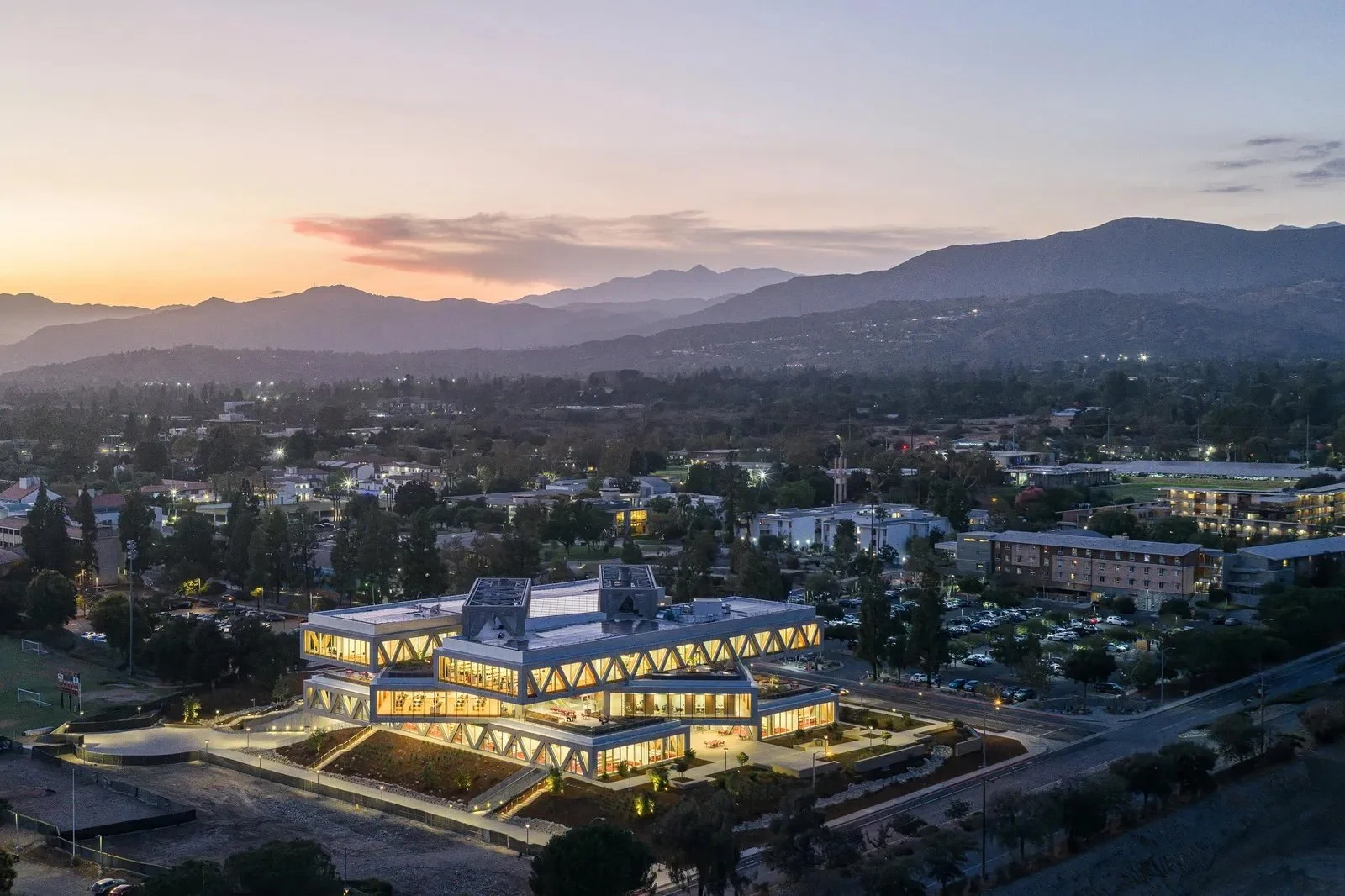
Claremont McKenna College, photo by Laurian Ghinițoiu, courtesy of BIG.
The Arts District, Claremont McKenna, and BIG's Vision for LA
Leon Rost is a Partner at Bjarke Ingels Group (BIG), the firm behind some of the most talked-about projects in architecture today. He leads BIG's Los Angeles office, which opened three years ago in a 1928 Paul Williams building in Santa Monica. Before that, he spent 12 years running major West Coast and international projects, including Google's next-generation campus in Mountain View and Toyota's Woven City prototype in Japan. His diverse portfolio is the backdrop for our conversation about what it takes to innovate in Los Angeles.
Leon walks us through BIG's recently completed Robert Day Science Center at Claremont McKenna College, a stacked, cantilevered structure designed to anchor the college's campus expansion. We also talk about the long road to entitlement for a mixed-use project in the Arts District — ten years in the making — and what it could mean for the neighborhood's revitalization. Plus, we touch on the LA River, the tension between LA's individualist culture and the density it needs, and what Copenhagen's development culture can teach us.
Listen on Apple Podcasts | Spotify
About Leon Rost
Leon Rost is a Partner at Bjarke Ingels Group (BIG) and leads the Los Angeles office, overseeing projects that span large-scale masterplans, workplaces, higher education, and residential design. He oversaw the design of 3 million square feet within Google’s next-generation campus—home to Google Gemini—reimagining the Silicon Valley workplace as a flexible, sustainable, and human-centered environment. He also played a key role in the Athletics Ballpark Masterplan, shaping a vision for an integrated sports district. Additionally, Leon led the visioning of Toyota’s Woven City, a prototype smart city exploring the future of mobility, robotics, and urban life. His expertise in institutional and campus planning includes work on the UC San Diego and Claremont McKenna College campuses, integrating architecture with campus design. His leadership on the Johns Hopkins University Student Center, the university’s first mass timber structure, has shaped a dynamic hub for academic and social life. Beyond large-scale projects, Leon has a strong focus on residential and hospitality design. His work on private homes along the Pacific Coast and Not A Hotel in Setouchi, Japan, creates bespoke spaces deeply connected to their surroundings. Leon’s projects shape how people live, learn, work, and gather, from urban-scale developments to private homes.
Topics Covered
Leon’s non-linear path to BIG
The question Leon’s team asks on every project: what's the gift we're offering?
Why BIG chose LA over San Francisco, and whether the city's ambition still matches its potential
What LA's approval process is costing developers
Setting up shop in a Paul Williams building in Santa Monica
Inside the Robert Day Science Center at Claremont McKenna
BIG's Arts District project: what happened, what's next, and why the neighborhood needs it
Favorite buildings and spaces in Los Angeles
-
Sam Pepper 00:00
My guest today is Leon Rost, partner at BIG, otherwise known as Bjarke Ingels Group, and certainly the driving force behind that Los Angeles office. Leon's portfolio is going to be the envy of a lot of architects. He bridges the gap between massive innovation, certainly human scale design. He oversaw the design of Google's next-generation campus in Mountain View, which is now home to Google Gemini, and led the vision for Toyota's Woven City, which is a prototype for the future of urban life. He also brings an expertise to the institutional level, from the mass timber Student Center at John Hopkins to projects we're discussing today at Claremont McKenna and the Arts District. It is not an exaggeration to say that he and Bjarke Ingels crew is shaping how we live, learn and work, and I'm excited to dive into what that means for the future of this city, Los Angeles. Leon, you've got this incredible background. Cal Poly grad, worked in Japan, Europe. Now you're back leading the charge for big in Los Angeles. Really appreciate you joining the show. Does this feel like a homecoming to you, or does the city feel different now to how you were when you were a student here?
Leon Rost 01:14
Yeah. Thanks, Sam. Thanks for the intro and thanks for having me. It's a little bit of both. I did spend my adolescence in California, in the Bay Area, and, as you mentioned, went to undergrad and in Cal Poly during that time. My fourth year, I had the pleasure of doing a study abroad program in Copenhagen, Denmark, and that's how I got introduced to Bjarke and got an internship at his firm at that time. This was before BIG, it was a firm called Plot, which he ran in partnership with Julien de Smedt, and that's how I first got exposed to the type of work that I'm doing now. And then I went on to work surf, as I call it, you know, kind of try out different jobs in different countries to really understand the full breadth of what is out there and what the profession is. And kind of naively so I would say, because, you know, I went to Japan next. I'm half Japanese as well. I spent my childhood in Japan thinking to reconnect with the culture and perhaps work there for maybe five years. I only lasted a year because the it was very different from what I expected. And that's when I was really first exposed to the major contrasts in the industry, where I became sort of accustomed to very quickly in Scandinavia, more kind of flat, hierarchical, non hierarchical way of working. And in Japan, it's very top down. In most offices. I worked with Shigeru Ban's office, where it really is kind of the master architect sketch that is the impetus for the design versus kind of more of a, let's say, a generative and kind of crowdsource type of approach.
Leon Rost 03:09
So after Japan, I wanted to return to Scandinavia try a few different things. So I to Sweden, and then to Norway, and then just the way the wind blows. I ended up in Portugal before returning to New York to work with with BIG at the opening of BIG's office in New York City in 2011 think that is when I realized I actually got lucky the first time around, in a way, that that finding big in that internship was really a serendipitous moment, and being able to relive that process and that culture, but in the kind of new mission of the Americas was a really, was really resonating with me. So I spent 12 years in that New York office, mostly working on West Coast projects, and just three years ago, we came to LA to open up shop here, to look after the West Coast. We were debating where we should locate the office, whether it's San Francisco or LA, and those were the main contenders, and LA just seemed like more of a open challenge, let's say, and just kind of more opportunity, just in the way the city presents itself, and the kind of more cavalier culture, I would say that kind of drew us here. So it's still new to me, in a way. But of course, California as a state, feels like home.
Sam Pepper 04:38
Is that path that you took, something that you look back on and you feel like is something that you would kind of recommend to other folks that are starting out is to try and get as many broad experiences as possible. Or do you think that you kind of got a little lucky in finding Bjarke Ingles and despite having all these different experiences? Is really that was the key experience that then was kind of your North Star, maybe kind of going forwards?
Leon Rost 05:07
Yeah, a little bit of both, I would say. I mean, luck is one way to put it, but it's also being able to recognize what it is that you resonate with and throwing your heart into it. So, I mean, I came across an exhibition of plots one evening, and it just kind of clicked. I was like, I think this is what I've been looking for, this kind of combination of clear narratives, a degree of just fun and joy in the architecture, these incredible models that really drew me in. And then I this kind of starry eyed, naive kid just went after it and bothered them until they gave me an internship, which only took a few days, actually, and before I knew it, I was sitting there. But at the same time, I think that reflection and contrast that working in different firms provides is would be a key to securing that path. Because I think if I had just stayed there, I would have always been left wondering what else is out there, and perhaps kind of suffering from this grass is greener lament.
Leon Rost 06:18
And I think I also just learned a lot that still does. It's not as if I discarded the things I've learned in other firms, for example, at Shigeru Ban's office, just the clarity with which shigerban can kind of draw out a fully fleshed out building and understand the dimensions of everything in a single stitting is something to aspire to. It still kind of informs how I sketch and draw today to become more and more precise and not just stay with scribbles. And then I think also just there is a bit of I kind of compare it to Japanese like baseball culture as well, right? It's like the same type of environment that produces athletes like Shohei Ohtani. It's grueling in the beginning. You have to go through the kind of boot camp type aspect of the first and do the dirty work and know what it takes at the bottom in order to get to the top, and you can't skip any steps. So that brings a degree of humility and a connection to all aspects that go into the work and go into the process.
Sam Pepper 07:26
How do you maintain that key factor, that fun factor in the design, which I think is, in some ways, kind of the special source of the company, is that projects that you do are legible and exciting to people who don't know anything about architecture, but they are living and working in their neighborhood, environment, city where they are and they see something and they're like, they just understand that's cool. Is it a hiring thing? Do you try and identify people who sort of embody that?
Leon Rost 08:01
I would say it's more of the process. We constantly critique ourselves that in various levels and kind of formats throughout the process, and ask a lot of different questions. But one of them is, really, what are we offering that no one is asking for? Sometimes we call it like a gift. What is the gift that's embedded into this project. What's going to make this project worth spending five years on? What is it that's going to keep us all excited and motivated? What is it that's going to get the community excited? In a lot of cases, these buildings require community buy in, and what is it that's going to get them sharing this across their networks, and saying, Can you believe this? And I think ultimately, just there is kind of an ethos of bringing our dreams to reality. We see our role as giving shape to future cities and future environments. And our job is not just to copy what's out there. It's what can we imagine that doesn't exist and help bring that into the world. So in order to arrive at that, you have to somehow, as part of the process. I almost kind of like, like aI terms are starting to infiltrate in all directions, but almost like a hallucination, if you use, like, an AI term, kind of create unexpected cross pollinations to see what might occur.
Leon Rost 09:27
So, you know, just one example, probably the best example of this is the ski slope on top of a power plant that we built in Copenhagen. So it's a waste to energy plant. It was a competition. The competition just asked for a facade wrap around what would be Copenhagen's bulkiest, largest building. We also thought about the rooftop and making it an accessible landscape. And through that process, making it a traversable mountain, it ends up becoming incredibly steep. Someone had. The idea on the team, what if we make it a ski slope, and at some point, you kind of look around and, do we? Do we do this? Is this? What do we have to lose, you know, and put it forth, and just as a side commentary, I think competitions also allow that kind of space for those types of ideas to germinate, because without actually fleshing that out and submitting it, it would have probably been shot down at the first conception of the idea, but kind of incubating these ideas and going through those steps, we do really still have to go through those quote, unquote, nerdy, technical hurdles to make a building happen, making sure that it's feasible, and not just the pie in the sky. Idea bringing all those components together to form a buildable executable piece of architecture.
Sam Pepper 10:51
You talk about bringing dreams to reality. And I think that Los Angeles is a city where that's been at the sort of the Heart of LA at least in its golden era, the company opened the office here at three years ago, which is right as of covid was winding down, and I think Los Angeles wasn't in its best spot. Do you still feel that about Los Angeles, that it's a place where your firm can make dreams reality and you can pursue the type of ambitious projects that that you're known for.
Leon Rost 11:31
Yes, I think the mindset is still very much alive. The other aspect of what made la what it is was the movie industry, obviously, right, the kind of imagination that's happening on the screens, in some ways, also translated into physical realm, though perhaps not nearly as great as it could have or should have, I would argue. And I've encountered and met and talked with a lot of people who have big dreams still, and really are thinking big about what could happen, but at the same time, be remiss not to acknowledge the bureaucratic gridlock that comes with realizing larger projects. The LA Arts District took us 10 years to get that approved, albeit there were some hiccups along the way with covid and program changes and so on. But the amount of freedom that people had more manifested in a smaller scale, I would say it's kind of a city of individualism, right? Like individual ideas and within your plot of land, within your as of right, plot go bananas, and no neighbor is going to raise an eyebrow. In a sense that kind of level of creativity feels a bit now fully saturated in the city, but at the same time, it's still not a very filled in dense city, in the sense of a lot of even in New York, people are just finding slivers of land to go up super tall European cities are kind of been locked in its final form for centuries now, for the most part.
Leon Rost 13:12
Now, let there's still quite a lot of swaths of land that are ripe for development. It's, I think our biggest obstacle is actually this kind of the nimbyism and the kind of people digging their heels into the status quo. So there's definitely a tension I feel between that desire for creativity and exploration and a bit of rigidity. It also feels like a city in transition right now. I'm a member of the biophilic Institute, where the mission is really to how can we have nature play a larger role in the way decisions and policy and physical environments are built out? And just one of the concepts that we talk about a lot is this regenerative cycle of destruction and rebirth and regrowth, perhaps best demonstrated by natural cycles of forests, right? Like forests are sort of naturally intended to burn, and that gives fertile ground for new saplings to grow up. And la does not have to go far from that metaphor. It literally did burn recently, and is time for regrowth. But it also feels like that in other aspects as well, like the entertainment industry is obviously a huge driver of La which is kind of at rock bottom right now, and I think in that moment of crisis, is definitely a new opportunity to rebuild and redefine itself. So I feel like there's a bit of, kind of, maybe nervousness. I've also kind of felt a lot of pessimism about the future, but I also feel like we're at the bottom of the cycle, and it's kind of the time for the rebirth aspect.
Sam Pepper 14:54
I mean, LA has gone through a series of pretty seismic events, luckily, not in. Actual seismic event, but we've gone through a lot over the past few years and still in a position where the city is running. And I think there's a feeling that I'm seeing, and obviously I talked to a lot of people about Los Angeles that it will reinvent itself. It always reinvents itself. Cities that like, I mean, after Sandy and after covid, people were saying, oh, everyone's going to move out of New York City. And New York City is, I think, probably the most resilient city in the US. But New York is back at a strength that is similar to how it's been. It's in its best periods today. And I think the new version of La may be slightly different to the old version of LA, but it'll be something that is exciting and still attracts that creative energy, which it was really founded on, and also, you know, this creative but also this very intense Industrial and Engineering base as well. I think people often forget that Los Angeles and the South Bay are, is one of the centers for, you know, aerospace engineering, nuclear engineering, in the country. And so you've got this really cool tension between the entertainment, the storytelling, the creative industry. And then you've got this really dialed in engineering phase. It's interesting that kind of contrast, and I think it's part of the reason that LA is really, really exciting. And I'm curious your experience in Copenhagen. Copenhagen is a, not a super high density city, but it is known for its creativity. It's certainly a design city. Do you think it's easier to build in Copenhagen than it is in Los Angeles in a lot of ways?
Leon Rost 16:45
Yes, in terms of just sheer audacity and expression, and in terms of just kind of esthetic or the design of a building, there may be limitations to fit in more contextually with the city, but a lot of the growth in Copenhagen is happening around the periphery. It's actually quite a small city center, so even what seems like the periphery is still just like a 15 minute bike ride from the center. The industry is moving out of the city, and these ports are being reclaimed for development and creating new neighborhoods. And I think the path to getting things built are more clear and more organized and more predictable and politically stable. So even though perhaps the maybe the beginning to end duration may not be so different for a project as big as the arts district, for example, I think the steps are more planned out and stay on schedule. Basically, you know, I think the further north you go in Europe, the more punctual the processes are.
Leon Rost 18:04
And I think in terms of innovation, a lot of it comes from different perspectives. I feel like the city community colleague architects, we're all aligned on some principles such as sustainability and creating spaces for the community or strengthen social bonds. So if you say you want to make a mass timber building, it's just for example, or provide a green roof, that's quite normal. That's kind of par for the course these days in Scandinavia. In fact, the laws around the carbon limits of buildings almost require it. They're starting to ratchet it down every year. So we're very soon approaching a point where, in Copenhagen, you won't have any choice but to build in carbon neutral materials. In the States, it's often a uphill battle to convince clients to implement these types of strategies. So I think, just like the bar is the starting point for a lot of these kind of aspects, which we would call innovative here, are already set quite high in Copenhagen.
Sam Pepper 19:18
I want to talk about your office a little bit so you moved into a 1928 Paul Williams Building in Santa Monica. Is it quite a beautiful building, and the interior you've left it fairly raw. I'm curious your A the approach on that building, but also why you selected Santa Monica? What was it about the west side that appealed to you?
Leon Rost 19:40
It was mostly the lifestyle.
Sam Pepper 19:45
You're a surfer, right?
Leon Rost 19:46
I am as well, yeah. So definitely, for personal reasons, I also wanted to be closer to the west side. I mean, that goes back to one of the previous questions about what makes la valuable and what it has. Staying power about LA, and it is the nature the ocean, the open ocean, the hills, the mountains. You don't have many cities in the world that are right up against an open ocean like that, perhaps harbors and bays and rivers. But that is, for me what makes la amazing. And just in my vision of La moving to LA would have seemed kind of a lost opportunity to end up in a dense urban environment after coming from New York. So seeking out what makes it unique, and I think also just shift after covid towards away from just more hardcore corporate work culture and towards kind of balancing life and work and nature and sunshine and leisure, it kind of fit the mold. Better to be in a small building embedded into a neighborhood with walkable streets and retail and restaurants and the Palisades walkways than to be taking an elevator to a glass office space.
Leon Rost 21:05
We did look all around the west side, and I fully thought that we would end up in a boat trust, typical la industrial building. And we looked at a lot of those, but when this building presented itself, it almost seemed too good to be true. I thought for sure that the tiles were asbestos, because there are these red tiles. That must be why no one is in here. But no, it was just kind of this diamond in the rough here a concrete building from 1928 which is pretty unusual, and it's a historically protected building, so really a dinosaur, by La standards. And it also just really looked like a lot of our other big offices. You know, we were in this kind of raw concrete space in DUMBO, we just built our own headquarters out of concrete in Copenhagen.
Sam Pepper 21:54
Which is amazing, the new headquarters look incredible.
Leon Rost 22:01
Yeah, it's like working in a museum. And the kind of volumes and visual connection between four plates are quite stunning. But yeah, it just, it just felt like a natural fit. And just as a nod to the historical architects that helped to form LA's history, obviously, Paul Revere Williams, just being a part of that history and embedded within this little Santa Monica Community. Although we weren't looking at any other properties in Santa Monica, I think when this one came up, it seemed like we couldn't pass it up.
Sam Pepper 22:32
I want to talk about a couple of the projects that you've worked on. One that opened up recently is on the Claremont McKenna campus. I think it's called the Robert Day Science Center. Is that right, which looks like series of Jenga blocks that are stacked diagonally to each other. The genesis of that project and how it was designed. Can you just talk a little bit about how the kind of that design came about to structure the project in that way?
Leon Rost 22:58
Yeah. So what's maybe not apparent by looking at the images of it, is how it fits into the future master plan of the campus. So we were tasked to not only design this building, but to anchor it on the far end of what would become their campus expansion, which they hadn't really designed yet either. So we had to simultaneously design a master plan and the building, which really gave us an opportunity to have them reinforce one another. So the Claremont campus today, its distinctive campus character are these modernist, quite simple bar buildings that are just that house, dorms, and some of them classrooms, and they march down and and frame a linear mall like kind of the main pedestrian park of the campus. So what, what we proposed, was to extend that mall and continue these bars marching down to really established that as its identity, and then at the end of it, creating this culmination of stacked parallel bars.
Leon Rost 24:09
So at the same time, the program asked for the combination of three different forms of sciences, the life sciences, data science and computer science as one integrated discipline. So we quite literally stacked those three different departments on top of each other, although inside the building, building programmatically, it's not that simple. We you know, it's more like separate into labs and offices and classrooms and so on, but really integrating all of those programs together into this stacked form, and then the diagonal rotation is actually setting the stage for a new diagonal mall, which is part of the master plan as well. So this current mall hits this building, rickashays it diagonally, kind of takes it into the atrium and spits it out the bottom floor to this new mall that's going to be created next, and opens up the southern part of the campus for development. So I like to think of it almost as placing the queen piece on a chessboard far into the board, and kind of opens up these new lines on campus and helps to structure their future strategy.
Sam Pepper 25:25
Was it challenging to convince the decision makers at Claremont McKenna about the design? I mean, I'm going to hazard a guess, this is not the world's most budget-friendly building.
Leon Rost 25:37
It's a private university, so it was very donor driven. So early on, we had these meetings with the donor, and as part of that, we presented a lot of ideas and a lot of different options. This is common for our process, especially when with a new client, and we're trying to feel out what the level of ambition is, what the kind of level of budget might be, because in the beginning, a budget was not provided. They just want to see what the ideas were. And we had everything from flat, single story, pancake buildings to more compact cube like buildings, and this one, which perhaps best addressed the Master Plan and the campus expansion. So once there was buy in for this concept, there was really no turning back. And of course, we had to still go through a lot of value engineering to arrive at where we did one of them being that there was originally an ambition to make this out of mass timber, but especially with this massing, with its kind of spans and cantilevers, it proved too costly and also technically difficult for a lab building, which has high stringent requirements for vibrations. So there were definitely sacrifices that were made, but in the end, the value created was justified by the buddy.
Sam Pepper 27:03
That's a great project. The other one that's on the board that's been getting a lot of publicity recently for all sorts of reasons, design being one of them is one in the arts district, which is multifamily, mixed use. And you mentioned earlier that it was 10 years to get that entitled, which honestly just gives me shivers, because I know the challenges going through entitlements in the city. What's the trajectory for that project? I think a lot of people are kind of curious about would love to see it. I mean that downtown LA and the arts district desperately needs investment. What's the next step for that project?
Leon Rost 27:40
So yeah, as you know, it's now been entitled and approved. So it becomes really an economic and logistical and phasing question at this point. So the developer is working with some contractors to understand what the ideal phasing and program deployment would be, as well as some shifting still of a program, potentially between office, retail, residential, hotel, within what's allowed within the entitlement, of course, to arrive at the right sequence. But there's definitely no illusion about what an amazing opportunity this is to have this now entitled, and it's just a matter of timing and strategy.
Sam Pepper 28:27
I know intimately the challenges of financing a project like that, and certainly can imagine some of the conversations that happening, but I do think that the arts district actually almost requires a project of that scale, in order to give it the sort of the shock that it needs to get back on track, because when I arrived in LA in 2019 downtown LA and the arts district were really benefiting from years of growth and good publicity, and they were really, I'd say, important cultural spaces for the whole country, where you felt like there were a lot of interesting ideas coming. There was interesting architecture coming. There were a lot of really exciting companies from all sorts of industries that were moving into these areas. The Arts District was still is a hotbed of fantastic restaurants, but it really became that in the 2010s I'm really hopeful for that project. Certainly hope it moves forward in whatever form it does. But I think that and the row and what Atlas is doing over there could really be a credible and really important additions to that area.
Leon Rost 29:43
Absolutely, I also think it's the path towards getting a more revitalized river to densify along the rivers, because it's too late, really, for re expanding the river and making an ecological corridor, because you need to widen it by a. Actor of four or five and displace 10s of 1000s of homes. So we're kind of stuck with the culvert and maybe some modifications of it, but to breathe life back into it and breathe love back into it is really about making it people's backyards, right and front yards, and the more people that kind of overlook it and use it that will become the driving force towards its revitalization.
Sam Pepper 30:28
So I'm always kind of blown away by how many challenges the revitalization of the LA River has had. I mean, they've had a series of phenomenal architects, landscape architects, that have been advocating for it for decades, and there's been political interest as well. New York had something similar different scale, but the Gowanus Canal, which went from being one of the most polluted areas in all of New York to being an area where you've got million dollar condos, so there's a precedent for it, and you see glimmers of hope, both in the arts district. And I would say Frogtown is an interesting area where you've got these quite large trees that are growing up in the middle of the LA River. And so it has a visual interest that maybe is lacking elsewhere. I still think, though, that people still think of the LA River and they think of someone like Clint Eastwood driving a Mustang down it like has this very iconic look. And the fact that the city is not leveraging that in pieces, in bite sized chunks, seems surprising to me, but you're right next to it. And I mean, I guess that's the Bellona Creek and around the Hayden tract and Culver City where the rapper is. But even there, there is this element that could be leveraged, and I think could certainly increase the value of those sites, but certainly increase the experience of those sites. It's surprising that someone hasn't that hasn't gained more traction than it has, and it frustrates me a little bit to be honest.
Leon Rost 32:07
Yeah, absolutely. What we'd like to see is obviously a large, infrastructural, sweeping change. But I think the reality is we need to see it done piece by piece, by improving the neighborhoods that abut them, and that's going to gradually stitch together to form a more cohesive experience throughout the river lien.
Sam Pepper 32:27
I've got one more question for you. What are your three favorite buildings or spaces in Los Angeles?
Leon Rost 32:33
I mean, maybe starting with building, I would say I love the Second Home by SelgasCeno in Hollywood. I think it's a really good example of what LA architecture and spaces could be. Is really cheaply done, as far as I can see. You know, these kind of pods that are just embedded in in a essentially a jungle, creating a really lovely workspace. And the only regret is that you don't experience anything from the street, right? You kind of come into this oasis, and then you're suddenly exposed to this bustling and wonderful work environment.
Sam Pepper 33:13
You're next to the Home Depot parking lot.
Leon Rost 33:16
Yeah, exactly, yeah. That's That's kind of the trade off with La everything's kind of introverted, but I think it just shows an example of what kind of La architecture slash landscape and urbanism could be, maybe as a number two, and kind of related to that is the UCLA campus at a much larger scale, obviously, I'm teaching a design studio there now this quarter, and have the pleasure of, kind of walking through that campus twice a week. And it just again, shows that there's a different way to do things you can do la urbanism in this way. Huge heritage trees, skating these walkways, massive parking structures that house all the cars, but then you get out of them and can enjoy these incredible environments and just a nice level of density where there's activity, but still lots of lawns to lounge on, and trees and benches to sit on, and recreation fields. So it's not that it's not possible to do here. There's examples of it, just perhaps few and far between. And then I think I'm kind of partial to my own neighborhood of Venice Beach, and obviously the beach itself being a draw, as we already talked about, but I think the neighborhood itself, it is really special and unique. And I think if you're a visitor there, of course, you see these kind of colorful characters, but living there, you realize they're actually like, they're my neighbors. They're people that so you know my neighbors include a rapper, a old like Las Vegas soul singer, you know a guy. Likes to wear devil horns every day, and and one guy who bikes by and tells me every day that I'm a champion. You know, it's just like these colorful cast of characters that I would have never thought of as being neighbors and people of a neighborhood. They kind of look like street performers to anyone walking by, but it just provides like a it's almost like living in a fantasy land. Kind of keeps keeps life interesting and exciting every day.
Sam Pepper 35:28
Well, Leon, really appreciate your time. Thanks so much for joining the show.
Leon Rost 35:32
Thanks, Sam. Really appreciate.
Did you love this episode? Let us know by rating and reviewing our show on Apple Podcasts. It’s easy - simply click this link, click on Listen on Apple Podcasts, scroll to the bottom of the page, and select “Write a Review”. Let us know what you liked best about the episode, and what others can expect when they listen to our show.
While you’re at it, consider subscribing to Building LA. When you subscribe, you can guarantee you never miss a conversation with one our renowned designers, architects, and developers. Subscribe now!